
The Global Economics Game
is designed to be a teaching tool for economics and other social
studies
courses such as history
at high schools, colleges, and universities. It engages students
by compelling them to employ basic principles in an interactive
format.
The game gives macro economics a global perspective and is an effective
way to integrate computer technology into the economics curriculum.
Special Offer: Purchase a 100
years site license for only $100
- Limited Time Offer -
SITE LICENSES: The site license is an authorization for
a school to allow students to access the game
at the school computers. It also permits demonstration and
applications
of the game in class rooms. The purchase of a site license includes one compact
disk and/or
download which can be used to copy the game into the school's
computer
network(s). The
site license is an excellent option for academic institutions such as
high schools and colleges. It affords
instructors
and departments the flexibility to determine the degree to which they
wish
to use the game as a supplement to their course(s). The site license is
especially useful for new adjunct instructors who are in the
process
of developing their courses. More importantly, the site license
provides all
students at
the institution access to the game at the site's computers without
violation of copyright. The license gives the school
permission to use the copyrighted software for instructional and
recreational purposes. The
price of a 100-year license is $100. Note: To acquire a
site
license, simply complete our
order
form (Simply select the 1-year to get the 100
years special offer or contact us to
arrange
a site license for a pending purchase order).
The
Global Economics Game is based on the macro model of Aggregate Demand - Aggregate Supply (AD-AS).
This model is presented in virtually every introductory economics text
currently being used at colleges and universities. It is now the
dominant framework used to teach macroeconomics. McGraw-Hill's
best-selling McConnel-Brue-Flynn "Economics" (19th edition) text added
the following: "During the recession of 2007-2009, the economic terms aggregate demand and aggregate supply moved from the
obscurity of economics journals and textbooks to the spotlight of the
national newspapers, Web sites, radio, and television." The Economist magazine, the New York Times, The Wall Street Journal and many
other business and economics publications now routinely make reference
to the AD-AS model in the titles and text of their articles. A
contemporary phrase used frequently to explain global economic
recessions and slowdowns is, "It's the aggregate demand, stupid."
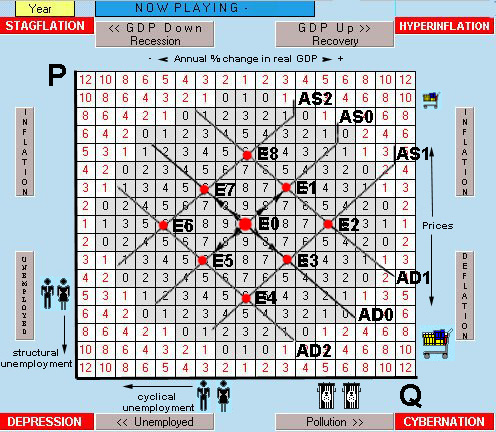
The diagram below shows the model of AD-AS
superimposed on the playing field of The Global Economics Game.
Countries in the game move around the playing field because of changes
in aggregate demand and/or aggregate supply that occur throughout the
game. The global economic indicator, current events, and
macroeconomic policies cause these changes.
Here are some examples of events and developments that are frequently
explained using this model:
1. The main cause of
"The Great Recession" (2007 - 2009) was a deficiency and decline in
aggregate demand causing the economy to move from E0 to E5 in the
diagram. The economy's real GDP (Q in the diagram) declines
and there is deflationary pressure on prices (P in the diagram).
Cyclical unemployment appears and increases with falling GDP.
Aggregate Demand is comprised of household consumption spending,
business investment, government purchases, and net exports. Most
economists think that consumer spending and business investment
declined in 2008 because of the housing crisis. Households,
especially many middle income familes, lost equity in their homes due
to plummeting home prices. This negative wealth effect caused
consumers to cut spending and businesses to cut investment spending.
2. The $152 billion
stimulus in 2008 and the $787 billion stimulus in 2009 were designed to
move the United States economy from E5 to E0. The latter is
called the "Economic Recovery and Reinvestment Act" and was a
combination of tax cuts and government spending increases. The
tax cuts would induce an increase in consumer spending.
Meanwhile, Ben
Bernanke, chairman of the Federal Reserve System, has been applying an
expansionary monetary policy to accommodate federal budget deficits and
induce borrowing and spending. Some economists warn that if
Bernanke increases the money supply by too much, then the economy would
eventualy get inflation and could move upward to E1, E7 or E8 on the
diagram.
3. The economic
slowdown in Europe, Japan and elsewhere is often explained as a
deficiency in aggregated demand (A0 to A5). Japan suffers from
anemic stimulus effects with increases in government spending and
banking reforms. European economies suffer from high debt/GDP
ratios which make them reluctant to increase government spending for
stimulus that would create even larger deficits and debt.
4. The Kyoto Protocol is an international treaty to
reduce greenhous gas emissions. The burden is placed on
industrialized countries, and critics argue that it will slow down the
global economy and cause prices to rise. If implemented, higher
production costs would cause
a decrease in aggregate supply and move the global economy from E5 to
E6 or E0
to E7. The debate is about
whether the marginal benefits are greater than the marginal costs or
the other way around. The U.S. has not ratified the treaty, but President
Barack
Obama recently proposed a "new climate initiative" that would stiffen
regulations on fossil fuel energy sources such as coal fueled electric
power plants. Those who support this initiative argue that the
inflationary
effects of this policy would probably be minimal and the decline in GDP
would be small compared to the decline in aggregate demand that has
been the principal cause of global economic slowdown.
5. Hurricane Katrina
(2005) and Storm Sandy (2012) caused decreases in aggregate supply and
moved the economy, especially in the regions hit, from E5 to E6.
Storm Sandy occurred when aggregate demand was already weak.
6. In 2007-08 there were fears that the spike in international oil prices would cause the economy to move to E7 just like the stagflation experience in the mid-1970s. However, the effects of the decrease in aggregate supply turned out to be modest compared to the 1970s because the amount of oil and gas used producing each dollar of U.S. GDP had declined significantly since the 1970s.
7. The prosperity of
the1990s, often referred to as the "New Economy," was explained
by long run increases in both
aggregate demand and aggregate supply that kept the economy close to E0
at full employment. Aggregate supply increased due to significant
increases in productivity during that period.
One of the main features of The
Global Economics Game is that
students
can visualize the effects of economic events and really enjoy playing
it while they are learning macroeconomics. Students
discover that economics
can
be interesting and engaging. Students can learn how to
play the game on their own by reading the abbreviated
instructions. If they want to learn more about the game
and winning strategies, they can read the full version of the
instructions. While
they are playing the game, students (1) acquire a macro economics
vocabulary,
(2) become increasingly more familiar with macro economic principles
and
policies, (3) begin to master the aggregate demand and aggregate supply
model, and (4) gain keen insights into the institutions and forces that
shape the global economy. The game visually helps students
understand
what the teacher is telling them in class lectures and what they are
reading
in their textbooks. From a pedagogical perspective, the game is
versatile
in its applications. Each instructor can determine the timing
and
degree to which the game is integrated into the curriculum.
1. Just assign students to play the game.
[Note: Students can print out the game scores at the end of a
game. The print out shows the date and time, the scores for each
player, and performance ratings for each country]. The 20th/21st Century
History version of the game is especially informative and fun to play.
2. Assign students to research economic events in one or more of the
decades of the 20th/21st century game. 3. Assign students to look up
terms in the game's text files and
glossary. 4. Assign take-home quizzes on macro topics and give
the students credit for playing the game in the same assignment.
5. Have a class contest. Let the students determine the rules of
the contest. Keep in mind that it is probably better to have the
students play against the computer than against each other. 6. Project
the game on a big screen, play the game, and invite student
participation. When on the policy page, call on a student to
choose which policy would be the most appropriate and ask them to
explain why. 7. Assign students to read one or more of the
informatve articles at the World
Economics News page of this web site.
Computer Lab
Activity:
Ideally, the game is presented to a class of students in a computer lab
setting. The instructor might demonstrate how the game is played at the
beginning of a session. This normally takes about 15 to 30
minutes.
Once students know how to play, they can begin to play against each
other
and/or computer managed countries. Groups of 2, 3, or 4 students
per station works best. Some students can complete the game
within
one hour the first time they play. After students become
familiar
with the game, it normally takes about 15 - 30 minutes to play a
standard
game to 100 points. As they are playing, the instructor can
be
available to answer questions. Questions generally pertain to how
to play, terminology, and the cause-effect relationships between
economic
variables. Working with a group of students who are
playing
The Global Economics Game in a computer lab setting can be one of the
most
rewarding activities that an instructor can experience.
Class Room
Presentations:
Project the game onto a screen in a class room. Divide the class
into groups. Each group is a country and designates someone to be
the president and congress responsible for fiscal policy, another to be
the trade representative, and another to be the central bank director
in
charge of monetary policy. The instructor describes and comments
on the events as they unfold. Every game is different. The
students enjoy picking their countries and participating in this
international
competition in the class room. Generally, this approach works
best
for relatively small classes.
SITE LICENSES: The site license is an authorization to allow students to access the game at your school computers. It also permits demonstration and applications of the game in the class room. It includes one compact disk or download which can be used to copy the game into the school's computer network(s). The site license is an excellent option for academic institutions. It gives instructors and departments flexibility to determine the degree to which they wish to use the game as a supplement to their course(s). The site license is especially useful for new adjunct instructors who are in the process of developing their courses. More importantly, it provides all students at the institution access to the game without violating copyright laws. The price of a 1-year license is $100. The price of a 100-year site license is only $100. To acquire a site license, simply complete our order form (Note: select the 1-year to get the 100 year special offer or contact us to arrange a site license for a pending purchase order).
BOOKSTORE ORDERS: Many students prefer to purchase their own CD's for personal use at home. They can place their own order directly from our web site, and/or the college bookstore can place an order through our order form. If you wish to have the CD packaged with the assigned text, please have your publisher contact us via e-mail. QUESTIONS AND INQUIRIES: Please feel free to contact us if you have any questions regarding the game and the best way to integrate it into your economics curriculum. Submit inquiries via e-mail: Send E-mail to: econgame. You may also contact us by mail at the following address: Economics Education Products, 6421 Timber Springs Ct, Santa Rosa, CA 95409.A Series of Lessons: Some instructors prefer a structured approach to integrating the game into their course. For your convenience, we have prepared a series of lessons that go well with the game. This makes it very easy for instructors to formally incorporate the game into their economics curriculum. Each instructor can determine which lessons are the most appropriate for his/her course and style. These are relatively high quality lessons that focus on the main topics of macro economics. Teachers and their students are welcome to download these lessons directly from this web site and modify them to suit the teacher's style:
Lesson 1:
Focus
on Opportunity Costs, Conflicting Goals, and Marginal Analysis
Lesson 2:
Focus on Measuring the Economy's Performance
Lesson 3:
Focus on Aggregate Demand and Aggregate Supply
Lesson 4:
Focus on Macroeconomic Policy
Lesson 5:
Focus on International Trade and Finance
Lesson 6:
Focus on Fiscal Policy
Lesson 7:
Focus on Monetary Policy
Lesson 8:
Focus on Market Failure and Externalities
Lesson 9:
Focus on Economic Analysis and Writing Reports
Lesson 10:
Focus on Research and Writing a Country Report
Lesson 11:
Focus on Comparative Advantage and Free Trade Areas (FTAs)
Lesson 12:
Focus on Game Theory and International Policy Coordination
Writing
Assignments:
Some instructors prefer to require writing assignments and more
in-depth
analysis than the above exercises entail. In this regard, We
have prepared a list of Suggested
Essay Questions that go well with the
game. They progress from
short-answer
questions to those requiring more extensive research and
analysis.
Many of these questions are thought provoking, and some require
extensive
historical research.
Return to Home Page Overview/Feedback/Awards How to Play/Features Scholarship Contest
World Economics News Exchange Rates
The World Game of
Economics
(C) 1999 Ronald W. Schuelke All Rights Reserved
The Global Economics
Game
(C) 2000-2004-2012 Ronald W. Schuelke All
Rights Reserved